
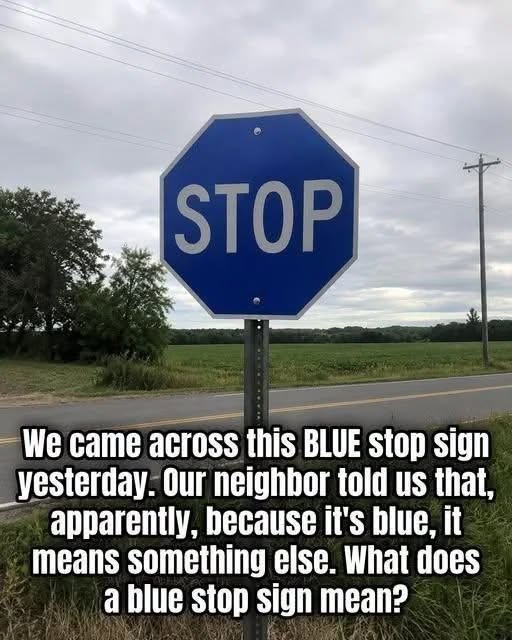
Imagine driving down a quiet country road when you suddenly notice something unusual: a blue stop sign instead of the familiar red one. The word STOP is clearly visible, the shape is unmistakable, and yet the color is completely different from what you would expect.
Would you stop? Does the blue color mean the sign has a different purpose? Could it be a special traffic sign, a private road marker, or simply an unusual local design?
Blue stop signs often attract attention because they look so different from the standard signs drivers are accustomed to seeing. However, the explanation is not always as mysterious as it might seem.
The meaning of a blue stop sign depends on where it is located, who installed it, and whether it is an officially recognized traffic-control device.
Why Are Standard Stop Signs Red?
In the United States and many other countries, standard stop signs are red with white lettering. This design is widely recognized, making it easier for drivers to identify an instruction to stop.
The distinctive shape also helps. A stop sign is octagonal, meaning it has eight sides. This shape allows drivers to recognize it even when the sign’s lettering is difficult to read or its face is partially obscured.
The combination of shape, color, and wording makes the stop sign one of the most recognizable traffic signs in the world.
Red is used for important traffic-control messages because it has a strong association with stopping and warning. Its contrast with white lettering also helps make the message visible under a wide range of conditions.
Because drivers are trained to recognize this design, a sign with the same shape and wording but a different color naturally raises questions.
Does a Blue Stop Sign Mean Something Different?
There is no universal traffic rule stating that every blue stop sign has a special meaning simply because it is blue.
In the United States, the standard stop sign is red. The Federal Highway Administration’s traffic-control standards specify the familiar red-and-white design for official stop signs on roads covered by those standards.
A blue octagonal sign displaying the word STOP may be an unofficial sign, a decorative sign, a private-property marker, or a sign used in a particular local context.
Its appearance alone does not establish its legal status.
The exact situation depends on the location and the applicable traffic laws.
For example, a sign installed at the entrance to a private parking area may not have the same legal status as a properly installed stop sign at a public-road intersection.
However, it would be unsafe to assume that a blue sign can always be ignored.
Drivers should pay attention to the road layout, other traffic-control devices, local rules, and any instructions given by authorized traffic personnel.
- It May Be a Sign on Private Property
One possible explanation is that the sign was installed on private property.
Private roads, farms, residential communities, industrial facilities, and parking areas sometimes use signs that differ from standard public-road designs.
A property owner may choose a different color for decorative reasons, to match the surroundings, or because the sign was obtained from a nonstandard supplier.
In these circumstances, the sign may communicate the owner’s intention that vehicles stop at a particular location.
Nevertheless, a blue sign is not automatically a legally enforceable stop sign merely because it displays the word STOP. Its status depends on the location, applicable law, and circumstances.
If you encounter one on a private road, proceed cautiously and follow any reasonable safety instructions.
- It Could Be a Decorative or Novelty Sign
Blue stop signs are also sold or displayed as novelty items.
They may appear on farms, rural properties, private driveways, themed businesses, or as part of decorative displays.
Some are intended to resemble official traffic signs, while others are designed to be humorous or visually distinctive.
A decorative sign might be installed near a driveway, on private land, or at the entrance to a property.
However, appearance alone cannot tell you whether a particular sign is decorative or officially authorized.
The surrounding road environment and the location of the sign matter.
- Could It Be a Local Traffic Experiment?
Traffic authorities sometimes conduct studies or implement special traffic-control arrangements, but an unusual sign should not automatically be assumed to be part of an official experiment.
In the United States, official traffic-control devices are governed by applicable standards and approval procedures.
A blue stop sign on a public road would be unusual and would warrant checking with the relevant road authority if its status were unclear.
Without knowing the exact location, it is impossible to determine whether the sign in the photograph was installed by a public authority, a private property owner, or someone else.
- Could the Sign Be From Another Country?